

Brigitte Bigi

Software

SPPAS — the automatic annotation and analysis of speech

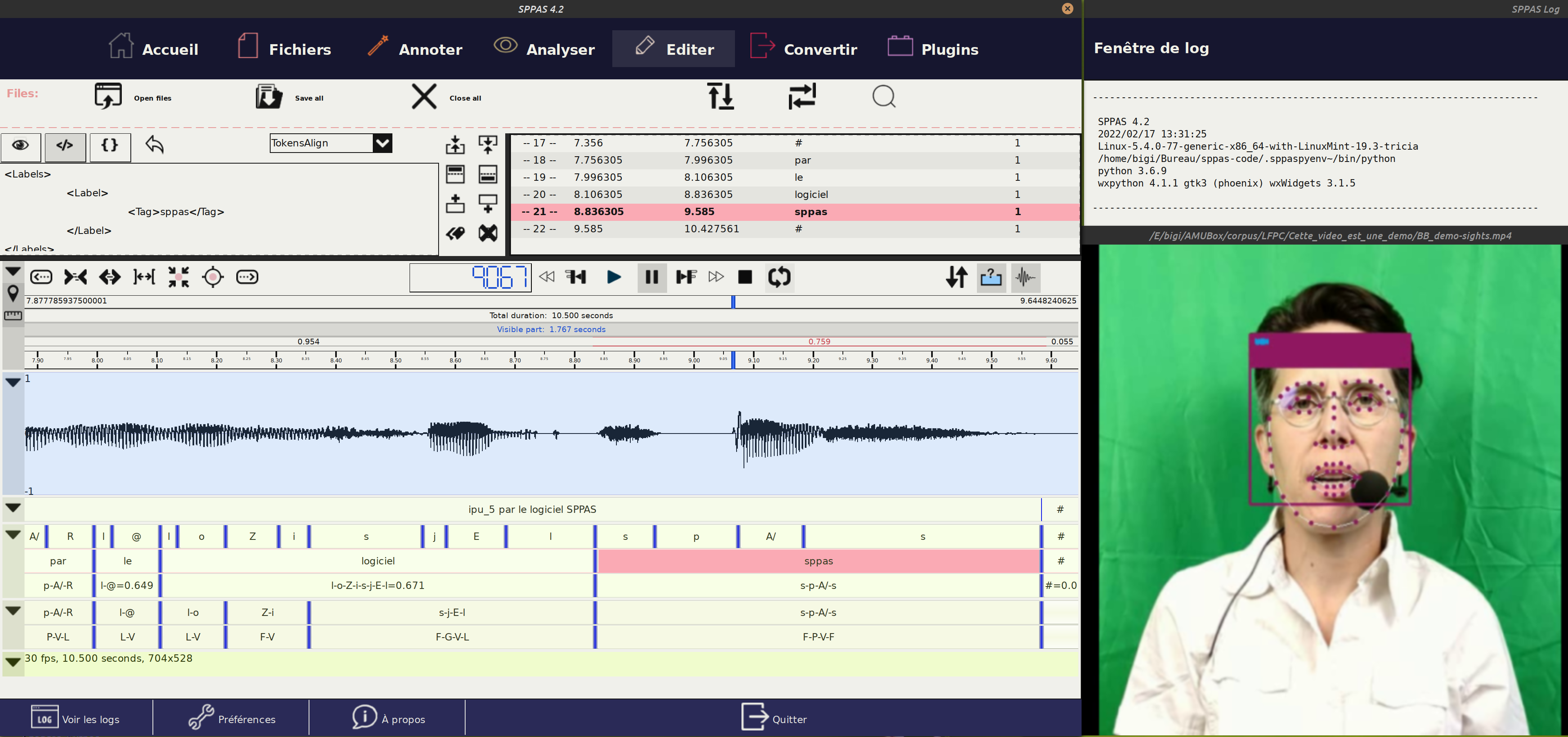
SPPAS screenshot

SPPAS is an open source annotation tool allowing to create, visualize and search annotations for audio/video data. Among others, it is able to produce automatically speech segmentation annotations from a recorded speech sound and its transcription. Some special features are also offered for managing corpora of annotated files.

SPPAS data files are XML-based, and SPPAS is compatible with Praat, Elan, Transcriber, and others. SPPAS runs on Windows, macOS and Unix platforms.

If you want to know why choosing SPPAS instead of WebMAUS, MFA, or any other segmentation tool, read this! If you don't have time to read the whole document, take a quick look at Table 1, 2 and 3 pages 20-25.


AudiooPy

AudiooPy logo SF logo Pypi logo HAL logo

AudiooPy stands for "Audio manager in Python Object-Oriented Programming." It is an open-source library that provides a range of useful operations for sound files and audio fragments. It processes audio at the frame level, working with signed integer samples of 8, 16, or 32 bits, stored in byte-like objects.

Key features include:

  • Reading and writing WAV files using Python's standard library.
  • A scientifically validated method for automatically detecting sound segments in speech.
  • Manipulation of raw audio data.
  • Audio mixing capabilities.
  • Automated computation of statistical descriptors for audio data.
  • Channel extraction.
  • Channel mixing.

AudiooPy is entirely self-contained and does not rely on any external libraries.


WhakerPy

WhakerPy logo GitHub logo Pypi logo HAL logo

WhakerPy is an open-source library to create dynamic HTML content and web-based applications. It allows creating and manipulating HTML from the power of Python:

  • Easy to learn, consistent, simple syntax;
  • Flexible and easy usage;
  • Create HTML pages dynamically;
  • Can save as static files; and/or
  • Run locally with its HTTPD server, or WSGI service, and its response "bakery" system.

Whakerexa

Whakerexa logo SF logo

Whakerexa exists to keep HTML readable and accessible without a heavy framework: semantic tags first, minimal classes, customization via CSS variables, and optional JS for behavior only. No private services, no tracking, works online and offline (bundle for file:// when needed).

Whakerexa offers CSS frameworks and JavaScript for any HTML content. It is intended to be as simple as possible to make accessible web content, and to minimize the use of CSS classes for enhancing the readability of HTML code.

It was designed to be easily customizable, allowing users to adjust properties such as fonts, colors, borders, etc., effortlessly. Most of the properties are stored into variables which makes possible to re-define them, then to obtain a custom different style, enabling users to achieve a unique style easily.


WhakerKit

WhakerKit logo SF logo Pypi logo HAL logo

WhakerKit is the ideal toolkit if you want to create a dynamic website with a few static pages, share documents easily without having to manage a database, restrict access to parts of your website using an existing LDAP directory, keep full control of your HTML content without the overhead of a heavy framework like Django.

It’s designed for developers who want a lightweight, flexible solution with minimal configuration.

It’s easy to deploy, easy to understand, and highly adaptable.

WhakerKit provides easy management of public and authenticated access and simplifies document sharing in collaborative environments.


ClammingPy

Clamming screenshot SF logo Pypi logo HAL logo

ClammingPy is an open-source library to convert a Python class or module into Markdown or HTML for documentation purposes. It supports reStructuredText and Epydoc formats. Docstrings are analyzed with flexibility rather than completeness.

ClammingPy generates HTML-5 with a high WCAG 2.1 conformity level.

More about ClammingPy...


ACSAnalysis

ACSAnalysis logo HAL logo

ACSAnalysis implements a reliable and reproducible extraction pipeline for French Cued Speech (LfPC) annotation analysis. The Python component reads annotated tiers produced by SPPAS, extracts key-level multimodal information (shape, position, phones, syllable structures, timings, sights, etc.), and converts them into a clean, analyzable tabular format. In addition to extraction, the package provides a set of Python analysis solutions that implement lightweight, reproducible statistical analyses. Among others, this component allows computing basic spatial and temporal distributions, generate summary statistics, and produce diagnostic visualizations (PNG) used to reproduce published results. The exports and analysis scripts apply on CLeLfPC - an open corpus on ortolang.fr forge, and are intentionally lightweight and descriptive. They are designed to reproduce published figures and summary statistics, following the FAIR principles.

ACSAnalysis is a joint work with Mélanie Lancien, Assistant Professor at Université de Lorraine, Nancy.


Auto-CS

autocs logo SF logo HAL logo

Auto-CS is a Python program developed within the project AutoCuedSpeech. It contains all the components dedicated to the automatic annotation of Cued Speech. This source code is not a standalone tool: it only runs inside SPPAS. It is integrated by means of the **spin-off** mechanism provided by SPPAS>=4.29, which allows external code bases to remain separate while still being dynamically discovered and used by the main framework.

The Proof-of-Concept of this system is described in the following reference : hal-04623112. The 1st stable version of this system is described in the following reference: hal-05242638.